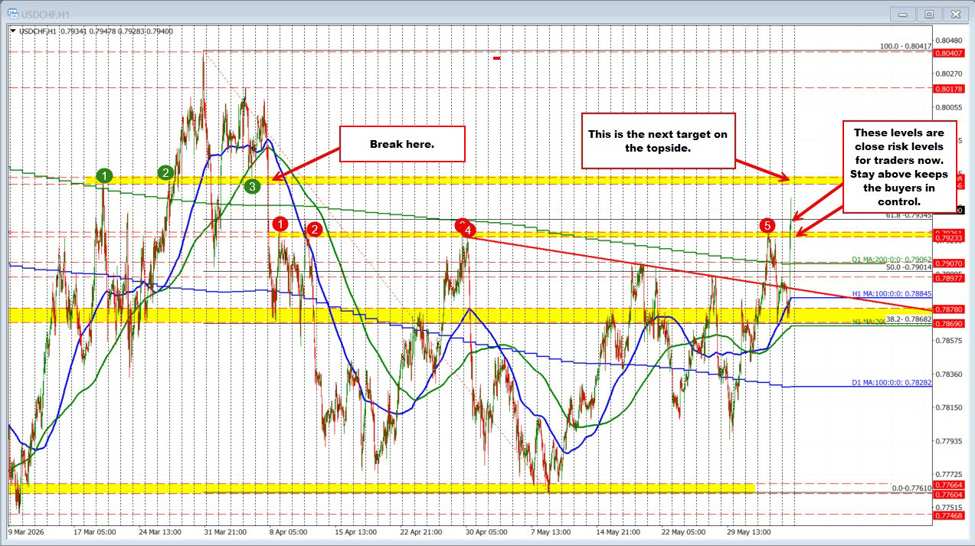
The USDCHF is breaking higher and gaining upside momentum as it pushes above a key resistance zone defined by the late-April and late-May swing highs between 0.7923 and 0.7926. The pair has also moved above the 61.8% retracement of the decline from the March 31 high to the May 8 low, which comes in at 0.79345. That combination of technical breaks gives buyers greater control in the near term. With the breakout now underway, the former resistance area between 0.7923 and 0.7935 becomes an important support zone. As long as the price remains above that area, buyers maintain the advantage and can continue to target higher levels. On the topside, the next key objective comes in between 0.7956 and 0.7961, an area that served as an important swing zone during March and April. A sustained move above that level would open the door for a run toward the 0.8000 psychological level, which is likely to attract increased attention from traders. Just above that sits another notable swing target near 0.8018, followed by the 2026 high at 0.80417. Looking at the broader chart, the sharp decline seen on April 7 and 8 left relatively little resistance overhead, giving the pair room to extend higher if bullish momentum remains intact. For now, the technical bias remains tilted to the upside, with buyers focused on holding above the breakout area and pressing toward the next resistance targets. Fundamentally, the move higher in USDCHF is being supported by a stronger U.S. dollar following the better-than-expected U.S. employment report. The jobs data pushed Treasury yields sharply higher, with the 2-year yield rising 10.8 basis points to 4.157% and the 10-year yield climbing 7 basis points to 4.547%. Higher yields are helping to boost demand for the dollar, adding a supportive fundamental backdrop to the pair's bullish technical breakout. This article was written by Greg Michalowski at investinglive.com.
USDCHF breaking higher the price is breaking away from recent swing highs
The USDCHF is breaking higher and gaining upside momentum as it pushes above a key resistance zone defined by the late-April and late-May swing highs between 0.7923 and 0.7926. The pair has also moved above the 61.8% retracement of the decline from the March 31 high to the May 8 low, which comes in at 0.79345. That combination of technical breaks gives buyers greater control in the near term. With the breakout now underway, the former resistance area between 0.7923 and 0.7935 becomes an important support zone. As long as the price remains above that area, buyers maintain the advantage and can continue to target higher levels. On the topside, the next key objective comes in between 0.7956 and 0.7961, an area that served as an important swing zone during March and April. A sustained move above that level would open the door for a run toward the 0.8000 psychological level, which is likely to attract increased attention from traders. Just above that sits another notable swing target near 0.8018, followed by the 2026 high at 0.80417. Looking at the broader chart, the sharp decline seen on April 7 and 8 left relatively little resistance overhead, giving the pair room to extend higher if bullish momentum remains intact. For now, the technical bias remains tilted to the upside, with buyers focused on holding above the breakout area and pressing toward the next resistance targets. Fundamentally, the move higher in USDCHF is being supported by a stronger U.S. dollar following the better-than-expected U.S. employment report. The jobs data pushed Treasury yields sharply higher, with the 2-year yield rising 10.8 basis points to 4.157% and the 10-year yield climbing 7 basis points to 4.547%. Higher yields are helping to boost demand for the dollar, adding a supportive fundamental backdrop to the pair's bullish technical breakout. This article was written by Greg Michalowski at investinglive.com.
The USDCHF is breaking higher and gaining upside momentum as it pushes above a key resistance zone defined by the late-April and late-May swing highs between 0.7923 and 0.7926. The pair has also moved above the 61.8% retracement of the decline from the March 31 high to the May 8 low, which comes in at 0.79345. That combination of technical breaks gives buyers greater control in the near term. With the breakout now underway, the former resistance area between 0.7923 and 0.7935 becomes an important support zone. As long as the price remains above that area, buyers maintain the advantage and can continue to target higher levels. On the topside, the next key objective comes in between 0.7956 and 0.7961, an area that served as an important swing zone during March and April. A sustained move above that level would open the door for a run toward the 0.8000 psychological level, which is likely to attract increased attention from traders. Just above that sits another notable swing target near 0.8018, followed by the 2026 high at 0.80417. Looking at the broader chart, the sharp decline seen on April 7 and 8 left relatively little resistance overhead, giving the pair room to extend higher if bullish momentum remains intact. For now, the technical bias remains tilted to the upside, with buyers focused on holding above the breakout area and pressing toward the next resistance targets. Fundamentally, the move higher in USDCHF is being supported by a stronger U.S. dollar following the better-than-expected U.S. employment report. The jobs data pushed Treasury yields sharply higher, with the 2-year yield rising 10.8 basis points to 4.157% and the 10-year yield climbing 7 basis points to 4.547%. Higher yields are helping to boost demand for the dollar, adding a supportive fundamental backdrop to the pair's bullish technical breakout. This article was written by Greg Michalowski at investinglive.com.
- The USDCHF is breaking higher and gaining upside momentum as it pushes above a key resistance zone defined by the late-April and late-May swing highs between 0.7923 and 0.7926.
- The pair has also moved above the 61.8% retracement of the decline from the March 31 high to the May 8 low, which comes in at 0.79345.
- With the breakout now underway, the former resistance area between 0.7923 and 0.7935 becomes an important support zone.
- On the topside, the next key objective comes in between 0.7956 and 0.7961, an area that served as an important swing zone during March and April.
- The jobs data pushed Treasury yields sharply higher, with the 2-year yield rising 10.8 basis points to 4.157% and the 10-year yield climbing 7 basis points to 4.547%.
What people are saying
Discussion
Hot takes
Loading takes…
Comments
Discussion · 0
Sign in to comment, like, and save articles.
Sign inLoading comments…