The USDCHF surged higher in trading yesterday, breaking above a key downward-sloping trendline near 0.7893 and then pushing through its 200-day moving average at 0.79066. That move marked the pair's first break above the 200-day moving average since April 8 and gave buyers the green light to extend the rally. Momentum carried the pair above the April 29 high at 0.79238, but the breakout lacked follow-through, and sellers quickly regained control. In trading today, sellers initially attempted to push the pair back below the 200-day moving average, but buyers stepped in near the 50% midpoint of the move up from the early-April low at 0.79014, helping spark another rally. However, that rebound also ran out of steam. Over the last several hours, selling pressure has intensified, driving the price back below the 200-day moving average (0.79066), the 50% midpoint (0.79014), and the previously broken trendline near 0.7892. The renewed downside momentum has taken the pair toward a critical support zone defined by the rising 100-hour moving average at 0.7866 and the 200-hour moving average at 0.7858. The session low has reached 0.7869 so far, with buyers attempting to defend the area. For sellers to gain firmer control, they will need to break and stay below both moving averages. It's worth noting that on Tuesday, the price briefly moved below these levels but quickly rebounded, reestablishing support and setting the stage for yesterday's rally. Buyers had their opportunity above the 200-day moving average and failed to maintain momentum. Now it's the sellers' turn. The key question is whether they can extend the move below the 100- and 200-hour moving averages, or whether dip buyers will once again defend support and drive the pair back toward the former trendline resistance near 0.7892. Fundamentally, the move lower in USDCHF has been driven by a combination of safe-haven demand for the Swiss franc and broad-based U.S. dollar weakness. Interestingly, Switzerland's CPI report came in weaker than expected today, but rather than weighing on the franc, the currency remained firm. One explanation is that softer inflation reduces the urgency for the Swiss National Bank to pursue additional aggressive rate cuts. With the market already anticipating a dovish SNB, the weaker inflation data did little to undermine the franc and may have even reinforced its relative appeal as a safe-haven currency amid ongoing uncertainty. This article was written by Greg Michalowski at investinglive.com.
USDCHF tumbles after run to the upside yesterday fails on the break of the 200 day MA
The USDCHF surged higher in trading yesterday, breaking above a key downward-sloping trendline near 0.7893 and then pushing through its 200-day moving average at 0.79066. That move marked the pair's first break above the 200-day moving average since April 8 and gave buyers the green light to extend the rally. Momentum carried the pair above the April 29 high at 0.79238, but the breakout lacked follow-through, and sellers quickly regained control. In trading today, sellers initially attempted to push the pair back below the 200-day moving average, but buyers stepped in near the 50% midpoint of the move up from the early-April low at 0.79014, helping spark another rally. However, that rebound also ran out of steam. Over the last several hours, selling pressure has intensified, driving the price back below the 200-day moving average (0.79066), the 50% midpoint (0.79014), and the previously broken trendline near 0.7892. The renewed downside momentum has taken the pair toward a critical support zone defined by the rising 100-hour moving average at 0.7866 and the 200-hour moving average at 0.7858. The session low has reached 0.7869 so far, with buyers attempting to defend the area. For sellers to gain firmer control, they will need to break and stay below both moving averages. It's worth noting that on Tuesday, the price briefly moved below these levels but quickly rebounded, reestablishing support and setting the stage for yesterday's rally. Buyers had their opportunity above the 200-day moving average and failed to maintain momentum. Now it's the sellers' turn. The key question is whether they can extend the move below the 100- and 200-hour moving averages, or whether dip buyers will once again defend support and drive the pair back toward the former trendline resistance near 0.7892. Fundamentally, the move lower in USDCHF has been driven by a combination of safe-haven demand for the Swiss franc and broad-based U.S. dollar weakness. Interestingly, Switzerland's CPI report came in weaker than expected today, but rather than weighing on the franc, the currency remained firm. One explanation is that softer inflation reduces the urgency for the Swiss National Bank to pursue additional aggressive rate cuts. With the market already anticipating a dovish SNB, the weaker inflation data did little to undermine the franc and may have even reinforced its relative appeal as a safe-haven currency amid ongoing uncertainty. This article was written by Greg Michalowski at investinglive.com.
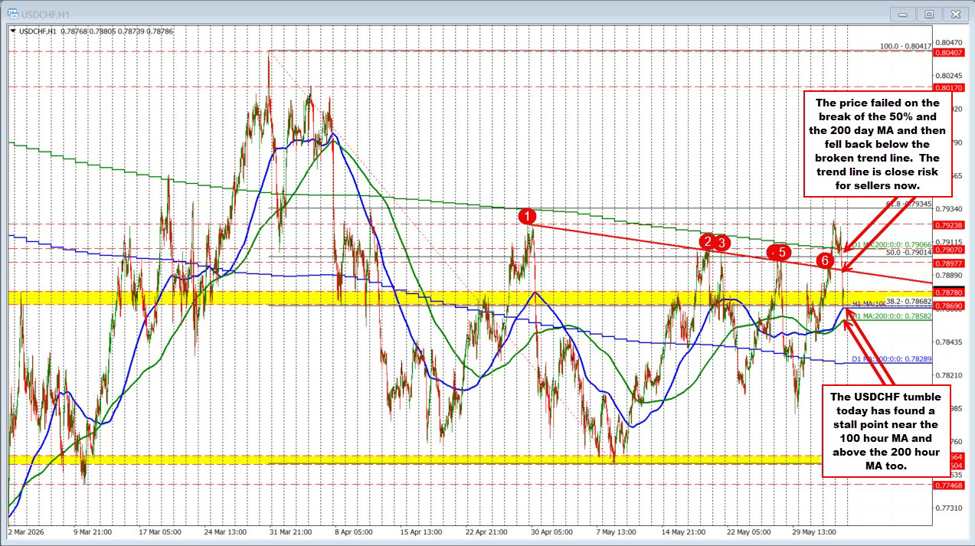
The USDCHF surged higher in trading yesterday, breaking above a key downward-sloping trendline near 0.7893 and then pushing through its 200-day moving average at 0.79066. That move marked the pair's first break above the 200-day moving average since April 8 and gave buyers the green light to extend the rally. Momentum carried the pair above the April 29 high at 0.79238, but the breakout lacked follow-through, and sellers quickly regained control. In trading today, sellers initially attempted to push the pair back below the 200-day moving average, but buyers stepped in near the 50% midpoint of the move up from the early-April low at 0.79014, helping spark another rally. However, that rebound also ran out of steam. Over the last several hours, selling pressure has intensified, driving the price back below the 200-day moving average (0.79066), the 50% midpoint (0.79014), and the previously broken trendline near 0.7892. The renewed downside momentum has taken the pair toward a critical support zone defined by the rising 100-hour moving average at 0.7866 and the 200-hour moving average at 0.7858. The session low has reached 0.7869 so far, with buyers attempting to defend the area. For sellers to gain firmer control, they will need to break and stay below both moving averages. It's worth noting that on Tuesday, the price briefly moved below these levels but quickly rebounded, reestablishing support and setting the stage for yesterday's rally. Buyers had their opportunity above the 200-day moving average and failed to maintain momentum. Now it's the sellers' turn. The key question is whether they can extend the move below the 100- and 200-hour moving averages, or whether dip buyers will once again defend support and drive the pair back toward the former trendline resistance near 0.7892. Fundamentally, the move lower in USDCHF has been driven by a combination of safe-haven demand for the Swiss franc and broad-based U.S. dollar weakness. Interestingly, Switzerland's CPI report came in weaker than expected today, but rather than weighing on the franc, the currency remained firm. One explanation is that softer inflation reduces the urgency for the Swiss National Bank to pursue additional aggressive rate cuts. With the market already anticipating a dovish SNB, the weaker inflation data did little to undermine the franc and may have even reinforced its relative appeal as a safe-haven currency amid ongoing uncertainty. This article was written by Greg Michalowski at investinglive.com.
- The USDCHF surged higher in trading yesterday, breaking above a key downward-sloping trendline near 0.7893 and then pushing through its 200-day moving average at 0.79066.
- In trading today, sellers initially attempted to push the pair back below the 200-day moving average, but buyers stepped in near the 50% midpoint of the move up from the early-April low at 0.79014, helping spark another rally.
- Over the last several hours, selling pressure has intensified, driving the price back below the 200-day moving average (0.79066), the 50% midpoint (0.79014), and the previously broken trendline near 0.7892.
- It's worth noting that on Tuesday, the price briefly moved below these levels but quickly rebounded, reestablishing support and setting the stage for yesterday's rally.
- One explanation is that softer inflation reduces the urgency for the Swiss National Bank to pursue additional aggressive rate cuts.
What people are saying
Discussion
Hot takes
Loading takes…
Comments
Discussion · 0
Sign in to comment, like, and save articles.
Sign inLoading comments…