
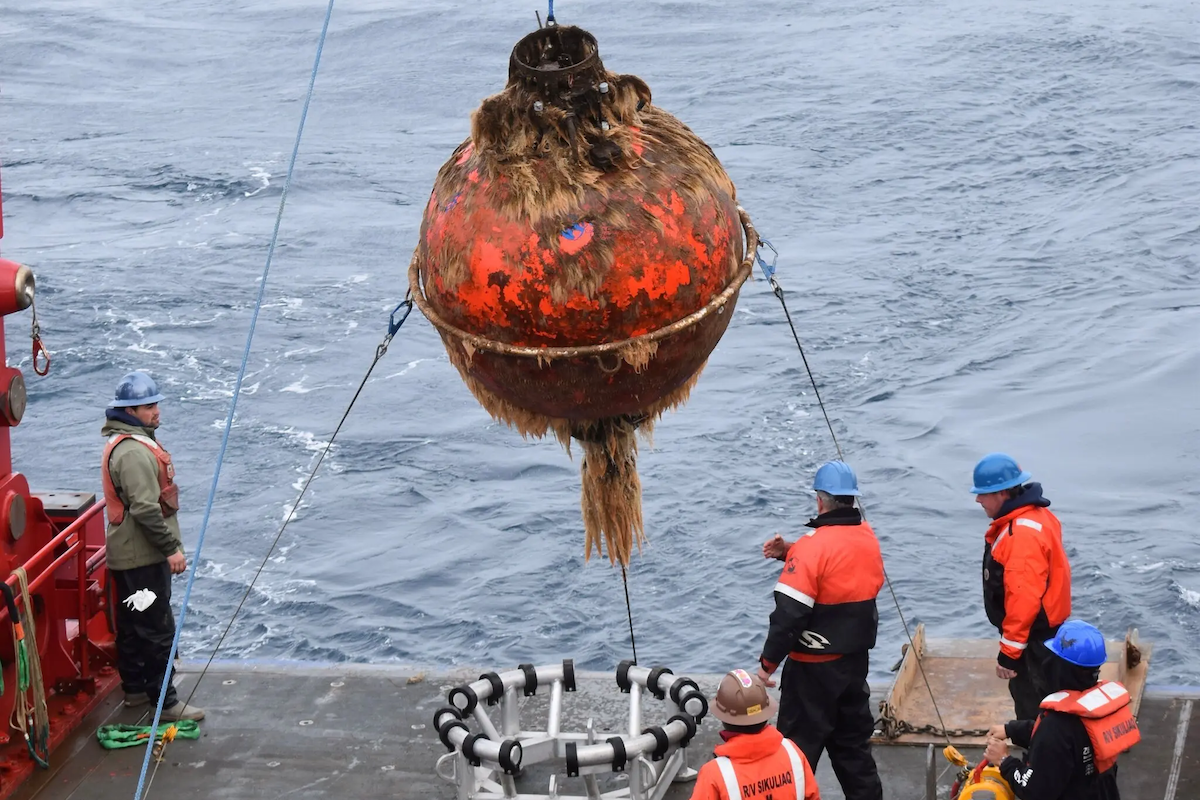
A mooring used in the Ocean Observatories Initiative is recovered off the coast of Alaska. Rebecca Travis / Woods Hole Oceanographic Institution The Trump administration is moving to dismantle an ocean observation system consisting of more than 900 instruments in the Pacific and Atlantic oceans. Data supplied by the system has been used to study key Atlantic currents that increasingly appear in danger of collapse as the climate warms.Just days after President Trump fired the independent board overseeing the National Science Foundation, the NSF announced the “removal of all in-water infrastructure” belonging to the Ocean Observatories Initiative at sites along the coasts of Oregon, Washington, Alaska, and North Carolina, and in the waters between Greenland and Iceland. Officials say the instruments will be recovered over the next 15 months.The system, which began operating in 2016, was designed to run for at least 25 years. After just a decade in operation, the loss of monitoring instruments will leave scientists without critical data on the state of oceans and marine life. That includes data on the Atlantic Meridional Overturning Circulation, or AMOC, a system of ocean currents that delivers warmth to northern Europe and shapes climate globally. Scientists are increasingly concerned the AMOC may be nearing a “tipping point,” after which it shuts down. Without sustained ocean observations, “we are effectively choosing to navigate an increasingly volatile ocean with diminishing visibility,” said Helen Findlay, of the Plymouth Marine Laboratory in the U.K. Growing uncertainty around the future of the AMOC, she said, “is precisely why long-term, consistent monitoring is more vital than ever.”Democrats in Congress have said they will “fight” plans to dismantle the system, The New York Times reports. Senator Sheldon Whitehouse, one of the more outspoken members of Congress on the subject of climate change, said on X, “Fossil fuel is heating our oceans by the zettajoule, so Trump’s corrupt fossil fuel stooges want to turn off the monitors.”ALSO ON YALE E360Why Fears Are Growing Over the Fate of a Key Atlantic Current
Global News·Jun 4, 2026
U.S. to dismantle system tracking Atlantic currents that are at risk of collapse
Article URL: Comments URL: Points: 392 # Comments: 258
Hacker News2 min readSingle source
The gist
5-point summary · 1 minArticle URL: Comments URL: Points: 392 # Comments: 258
- A mooring used in the Ocean Observatories Initiative is recovered off the coast of Alaska.
- Officials say the instruments will be recovered over the next 15 months.The system, which began operating in 2016, was designed to run for at least 25 years.
- That includes data on the Atlantic Meridional Overturning Circulation, or AMOC, a system of ocean currents that delivers warmth to northern Europe and shapes climate globally.
- Scientists are increasingly concerned the AMOC may be nearing a “tipping point,” after which it shuts down.
- Without sustained ocean observations, “we are effectively choosing to navigate an increasingly volatile ocean with diminishing visibility,” said Helen Findlay, of the Plymouth Marine Laboratory in the U.K.
Integrity note · Xela does not rewrite or paraphrase article content. The excerpt above is the source publication's own words, sanitized for display. For the full piece — including any quotes, charts, or images — read it at Hacker News. Xela's rewritten version is off for this story, so there's no editorial angle attached — you're getting the source's reporting unfiltered. When the rewrite is on, we add a What this means block underneath with the operator/trader takeaway.
What people are saying
Discussion
Hot takes
0/280
Loading takes…
Comments
Discussion · 0
Sign in to comment, like, and save articles.
Sign inLoading comments…